

In the high-stakes world of volleyball, the delicate balance between stress and performance can make or break a game. Enter the Yerkes-Dodson stress curve – a timeless theory that charts the ebb and flow of stress and its impact on athletic performance. Join me, as we dive into the world of volleyball and uncover the secrets of peak performance on the court.
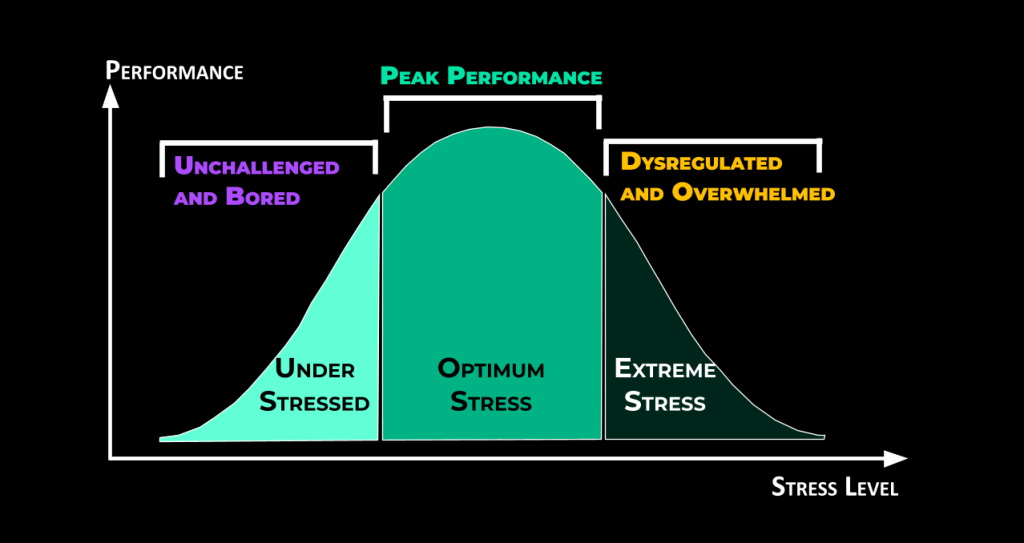
The Yerkes-Dodson Stress Curve: A Game-Changer for Volleyball Athletes
For volleyball athletes, the Yerkes-Dodson stress curve is more than just a theory – it’s a roadmap to success. Picture this: you’re on the court, the pressure mounting with each attack and dig. As stress levels rise, so too does your performance, but only to a point, reaching its peak at the pivotal moments of the game. But beware the pitfalls of excessive stress, which can lead to errors, fatigue, and missed opportunities. The key lies in finding that sweet spot of optimal arousal – the point where stress fuels your performance without overwhelming you.
Strategies for Peak Performance on the Volleyball Court
So, how can volleyball athletes harness the power of the stress curve to elevate their game? Enter mental training. There are many types of mental training and techniques, but let’s start with an overview. Here are the two types of practices that athletes can use to impact their stress curves.
- Acute Practices – In-game realtime practices that lower heart, sharpen focus, calm the mind and modulate the nervous system. We can use these when we are not in our peak stress window and want to get closer to it.
- Foundational Practices – Off the court practices that either broaden your stress curve (improve your ability to tolerate increased stress) or heighten your stress curve (raising your baseline performance and peak-level performance).
Acute Practices: Your In-Game Toolkit
Stress can feel like a hurricane of emotion and can overcome us easily if we do nothing. Acute practices are like putting down sandbags and nailing boards to the windows of our house to ensure we are safe. The most important thing about acute techniques is that they are easy to remember when the pressure comes. Now this is especially important because when stress rises, our thinking can get cloudy. So in these pressure situations we want to know exactly the technique(s) that we want to use. Now these can be as simple as a single deep breath, quick visualization, cue or mantra that you repeat, or physical trigger. But in general we want these acute techniques to allow us to:
- Embrace the Pressure: In volleyball, pressure is par for the course. Rather than fearing it, embrace it as a sign that you’re pushing your limits and competing at your best. Use pressure as fuel to elevate your performance and rise to the occasion when it matters most.
- Focus: In high-stakes competition, staying present is key. Focus on the here and now, what you can control, and letting go of past mistakes and future worries. By staying present, you can make split-second decisions, react quickly to changing situations, and perform at your peak.
- Positive Self-Talk: Volleyball is as much a mental game as it is physical. Plant seeds of positive self-talk for the situations that are pushing you to your limits and allow yourself to stay motivated, determined and positive.

Foundation Practices: Expanding your Stress Curve
Off the court, you can impact your mental game every single day. Thinking of stress as a hurricane, foundational practices are like building our house, foundation, walls, roof, everything. The more we build our foundation, the better prepared we are to deal with the storm when it comes. Foundational practices are things like: Mindfulness, Mental Rehearsal, Gratitude, Affirmation and Breathwork. The key to foundational practices are:
- Consistency: Using foundational practices only works as well as you train them. If you try to build a house in 1 day, how well will it hold up in a hurricane? Consistency is key to mental training.
- Simulation: Rehearsing pressure situations is an incredible way to simulate your mental and physical response for when you’re actually facing that pressure situation.
- Presence & Choice: Practicing being present in ANY moment is the best way to practice being present in pressure moments. This includes observation of feelings, thoughts, sensations, etc. If we are unaware of these phenomena, then they can control us. If we are aware of the present moment and our reactions, we can choose.
Conclusion
In the arena of volleyball, the Yerkes-Dodson stress curve is your secret weapon – a roadmap to navigating the highs and lows of competition with skill and grace. By understanding the dynamics of stress and performance, and implementing practical strategies tailored for volleyball, you can unlock your full potential and achieve greatness on the court. So, ride the wave of the stress curve, and use acute and foundational practices to harness its power to propel you to victory and glory on the volleyball court.
To try the first day FREE of our mental training program that features Olympic Athletes and an award winning curriculum team of neuroscientists, visit: innergameofvolleyball.com


 Inner Game of Volleyball
Leave a comment